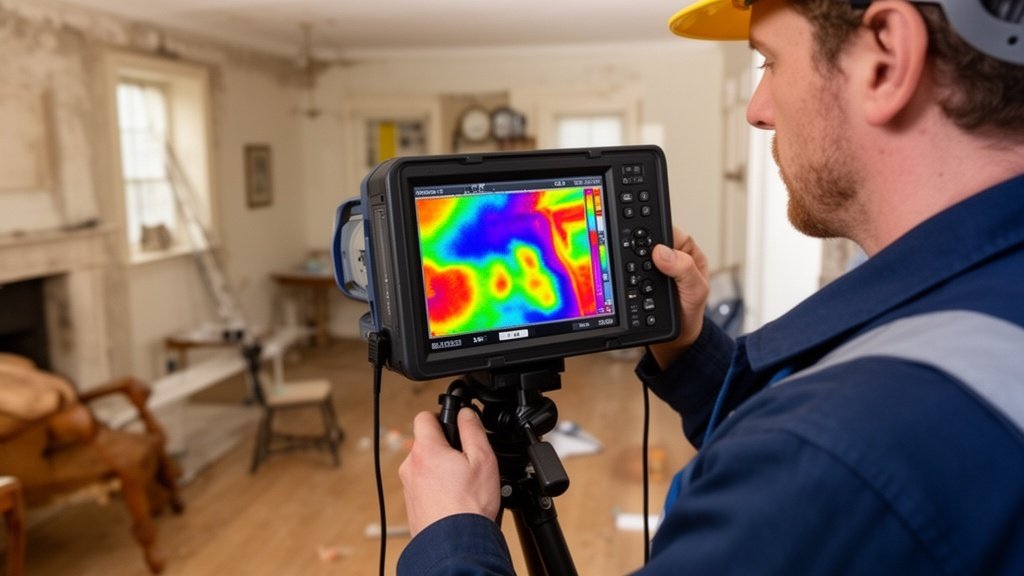
Coventry Surveyors use thermal imaging cameras to spot heat loss, damp, and hidden defects that the naked eye simply cannot see. In this guide, we explain exactly what thermal surveys are, how they work, and why they are fast becoming essential for Coventry homebuyers and property owners alike.
What Is a Thermal Imaging Survey?
A thermal imaging survey — sometimes called an infrared survey — uses a specialist camera to capture the heat signatures of a building's surfaces. Every material emits infrared radiation, and a thermal camera converts these emissions into a colour-coded image. Cold areas appear blue or purple; warm areas show as yellow, orange, or red.
In a property survey context, unexpected temperature variations can reveal a wide range of problems, from gaps in insulation and cold bridges to hidden water ingress and even overloaded electrical circuits. Unlike a traditional visual inspection, thermal imaging is non-invasive — there is no drilling, no opening up of walls, and no disruption to the property.
At Coventry Surveyors, our RICS-accredited professionals carry Level 1 and Level 2 thermography qualifications, meaning we can interpret what we see accurately and produce reports that are meaningful and actionable.
Key Fact
A 2023 report by the Energy Saving Trust found that 35% of UK homes have significant insulation defects that contribute to excessive heating bills. Thermal imaging is the fastest way to find them.
What Can a Thermal Imaging Survey Detect?
Thermal cameras are versatile diagnostic tools. Here is what our surveyors regularly find during thermal imaging inspections across Coventry and the wider West Midlands:
1. Insulation Defects
Missing, settling, or damaged insulation shows up clearly as a cold patch on a thermal image, particularly in loft spaces, cavity walls, and floor voids. In Coventry's Victorian and Edwardian terraces, cavity wall insulation was often retrofitted in the 1980s and 1990s. Over time, this insulation can slump, leaving the upper portions of walls completely unprotected. A thermal survey will reveal exactly where this has happened.
One of our clients in Styvechale discovered — thanks to a thermal survey before exchange of contracts — that three of her property's external walls had almost no functional cavity insulation remaining. The vendor agreed to reduce the price by £4,200 to cover professional re-injection.
2. Cold Bridges
A cold bridge is a point in a building's structure where heat bypasses the insulation and travels directly through a more conductive material. Concrete lintels, steel beams, and window frames are common culprits. Cold bridges increase energy bills and, more seriously, can lead to condensation and mould growth at the affected points — which often gets misidentified as rising damp.
3. Water Ingress and Damp
Water evaporates, and as it does so, it cools the surrounding surface. A thermal camera detects this cooling effect, making it possible to find areas of dampness even inside walls or beneath floors. This is especially valuable in older Coventry properties where damp courses may have failed or where roof defects are allowing water to penetrate silently behind plasterboard.
4. Roof and Flat Roof Defects
Flat roofs are notoriously difficult to inspect visually, especially when they appear intact on the surface. However, water that has penetrated the membrane and become trapped in the substrate retains heat during the day and releases it slowly after dark. A thermal survey conducted at night can reveal exactly where the trapped water is located, allowing for targeted rather than wholesale replacement.
5. Underfloor Heating Issues
If you are buying a property with underfloor heating, thermal imaging can verify that the system is working correctly and that heat is distributed evenly. Cold patches on an underfloor system usually indicate a damaged pipe or a failed zone controller.
6. Electrical Hotspots
Overloaded circuits, loose connections, and failing components all generate heat. Thermal imaging of an electrical consumer unit and key circuits can identify potential fire hazards before they become dangerous — something a standard visual electrical inspection cannot do.
7. Air Leakage Paths
Draughts increase energy bills and make homes uncomfortable. Thermal imaging, particularly when combined with a blower door test, can map every significant air leakage path in a property — around windows, service penetrations, loft hatches, and suspended timber floors.
When Is the Best Time to Carry Out a Thermal Survey?
For building fabric inspections, thermal surveys work best in winter or on cold autumn days when there is a temperature differential of at least 10°C between inside and outside the building. The greater the temperature difference, the clearer the thermal images will be.
The property should ideally be heated to its normal indoor temperature for several hours before the survey. Most of our Coventry thermal surveys take place between October and March for this reason.
Electrical and underfloor heating surveys can be carried out at any time of year, as they do not rely on external temperature differentials.
Case Study: Chapelfields, Coventry
Martin and Julie were purchasing a 1930s semi-detached house in Chapelfields. The sellers had just had new render applied to the external walls and the property looked immaculate. Our Level 2 Building Survey included thermal imaging as standard.
The thermal survey revealed a large area of moisture trapped beneath the new render on the front elevation — likely caused by the render being applied over existing damp rather than after remediation. The moisture was completely invisible to the naked eye.
Armed with this information, Martin and Julie negotiated a £6,500 price reduction and required the vendor to provide a professional damp investigation report before completion. "Without the thermal camera, we would never have known," Martin told us.
Thermal Imaging Versus Traditional Building Surveys
Thermal imaging does not replace a traditional Level 2 or Level 3 Building Survey — it enhances it. A surveyor uses a combination of tools, knowledge, and experience to assess a property. Thermal imaging is one powerful tool in that toolkit.
Equally, a thermal survey on its own, without the context of a full building survey, can be misleading. Temperature variations have many causes, and it takes a qualified professional to distinguish between a serious defect and a benign variation caused by, for example, a recently refilled water tank or a warm water pipe running beneath the floor.
"At Coventry Surveyors, our thermal imaging is always conducted and interpreted by a qualified surveyor, never a technician working in isolation. This ensures that every thermal anomaly is assessed in context and reported accurately." — Sarah Mitchell, Surveyor
How to Prepare Your Property for a Thermal Survey
If you are commissioning a thermal survey on a property you already own, there are a few simple steps you can take to get the most useful results:
- Heat the property normally for at least four hours before the survey — the longer the better.
- Close all blinds and curtains the night before to prevent solar gain distorting the results.
- Clear access to external walls where possible, moving furniture a short distance away from walls.
- Switch off floor heating (unless it is being tested) for at least 24 hours before the survey.
- Avoid cooking or using appliances near survey areas during the inspection where practical.
Understanding Your Thermal Survey Report
After a thermal imaging survey, you will receive a detailed report from Coventry Surveyors that includes:
- Full-colour thermal images of all significant findings
- Corresponding visible-light photographs for comparison
- A clear explanation of each finding in plain English
- An assessment of severity (urgent, significant, or advisory)
- Recommended next steps or specialist investigations
- An overall summary suitable for use in property negotiations
We write our reports in straightforward language, free of technical jargon. Our aim is that you understand exactly what we found and what you should do about it.
Thermal Imaging for Commercial Properties in Coventry
Thermal imaging is not limited to residential properties. Commercial property owners in Coventry are increasingly using thermal surveys to satisfy energy compliance requirements, identify maintenance priorities, and reduce operating costs. Our team carries out thermal surveys on retail units, offices, warehouses, and light industrial premises across Coventry, Warwickshire, and the wider West Midlands.
For commercial clients, thermal imaging can also support MEES (Minimum Energy Efficiency Standards) compliance work, helping property owners understand what improvements are needed to achieve an EPC rating of E or above before letting.
The Cost of a Thermal Imaging Survey in Coventry
The cost of a standalone thermal imaging survey in Coventry typically ranges from £250 to £600 for a standard residential property, depending on size and complexity. When combined with a Level 2 or Level 3 Building Survey, thermal imaging can often be added for a significantly reduced fee.
Given that thermal imaging can identify defects worth many thousands of pounds, and given that the information can be used in price negotiations, the cost of a thermal survey is almost always justified on financial grounds alone.
Frequently Asked Questions: Thermal Imaging Surveys
Thermal imaging is very effective at detecting active damp where moisture is causing surface cooling. However, it cannot detect all types of damp in all conditions. For a comprehensive damp assessment, we combine thermal imaging with moisture meter readings and, where necessary, specialist damp investigation by a qualified damp contractor.
Yes. At Coventry Surveyors, thermal imaging is included as standard in our Level 3 Building Survey and can be added to a Level 2 Home Survey for an additional fee. We believe it should be a routine part of any pre-purchase inspection.
Absolutely. Thermal imaging is particularly valuable in new-build properties because it can reveal defects in insulation installation that would otherwise be concealed behind finished surfaces. It is an excellent addition to a snagging survey or a new-build inspection.
A thermal imaging survey of a typical three-bedroom semi-detached house in Coventry takes approximately 1.5 to 2.5 hours. Larger properties or those with more complex issues will take longer. The report is usually delivered within three to five working days.
A thermal imaging survey is a separate inspection to a mortgage valuation and does not directly affect your lender's decision. However, if the survey reveals significant defects, you may wish to renegotiate the purchase price, which could affect your loan-to-value ratio.
Why Choose Coventry Surveyors for Thermal Imaging?
Our team has been conducting thermal imaging surveys across Coventry and Warwickshire for over a decade. We are RICS-regulated, which means we are held to the highest professional standards in the industry. Our thermal cameras are calibrated regularly, our surveyors hold recognised thermography qualifications, and every report is reviewed by a senior surveyor before it is issued to you.
We know Coventry's housing stock intimately — from the Victorian terraces of Earlsdon and Chapelfields to the post-war semis of Binley and the modern developments around the city centre. This local knowledge means we understand what defects are most common in each property type and location, and we know where to look first.
To find out more or to book a thermal imaging survey, explore our full range of survey services or contact our team today. We cover the whole of Coventry and the surrounding areas, including Kenilworth, Leamington Spa, Nuneaton, and Rugby.
Book Your Thermal Imaging Survey Today
Our RICS regulated surveyors use the latest thermal cameras to find what the naked eye can't. Get a free, no-obligation quote today.
Request Free QuoteRelated Articles
Ready to Book Your Thermal Imaging Survey?
Get in touch with Coventry Surveyors today for expert thermal imaging advice and a free, no-obligation quote.