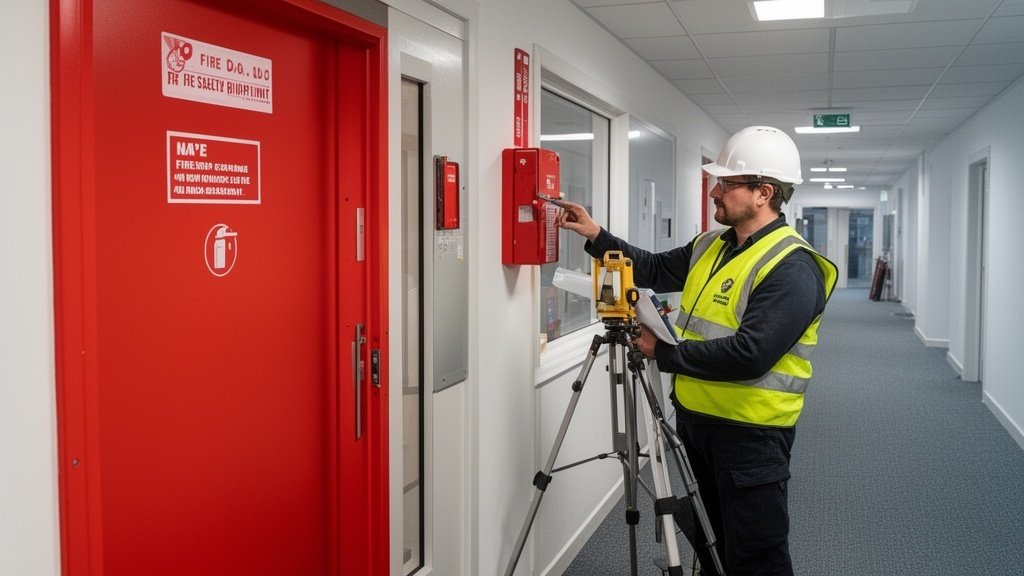
A fire risk assessment is a legal requirement for virtually every non-domestic premises in England and Wales. If you run a business in Coventry — whether a small office, a restaurant, a retail shop, or a large industrial unit — you must have a suitable and sufficient fire risk assessment in place, and you must act on its findings. This guide explains everything you need to know.
The Legal Requirement for Fire Risk Assessments in Coventry
The Regulatory Reform (Fire Safety) Order 2005 (commonly known as "the Fire Safety Order" or FSO) places legal responsibility for fire safety on the "responsible person" for any non-domestic premises. In a business context, this is typically the employer, the owner, or the person who has control of the premises.
The FSO was significantly strengthened by the Fire Safety Act 2021 and the Building Safety Act 2022, particularly for higher-risk residential buildings. The key requirement remains: you must ensure that a "suitable and sufficient" fire risk assessment is carried out and that you implement any recommendations it makes.
Failure to comply can result in enforcement notices, prohibition notices (which close your premises immediately), unlimited fines, and in cases of serious negligence, imprisonment.
Did You Know?
The West Midlands Fire Service carries out regular audits of commercial premises in Coventry. Businesses found to have inadequate fire risk assessments or non-compliant fire safety measures can face immediate enforcement action, including closure.
Who Needs a Fire Risk Assessment?
Under the Fire Safety Order, you need a fire risk assessment if you are the responsible person for:
- Workplaces of any size — offices, factories, warehouses, workshops
- Premises open to the public — shops, restaurants, pubs, cinemas, leisure facilities
- Houses of Multiple Occupation (HMOs) — student accommodation, bedsits, shared houses
- Blocks of flats — the common areas must have a fire risk assessment
- Educational premises — schools, nurseries, colleges
- Healthcare premises — GP surgeries, dental practices, care homes
- Places of worship — churches, mosques, temples
- Community and leisure buildings — sports centres, libraries, community halls
Private dwellings occupied by a single household are exempt — but if you rent any part of your home as an HMO or short-term letting, the Fire Safety Order may apply to you.
What Does a Fire Risk Assessment Cover?
A fire risk assessment is a systematic evaluation of your premises from a fire safety perspective. At Coventry Surveyors, our assessors follow the five-step process recommended by the UK government:
Step 1: Identify Fire Hazards
We identify all sources of ignition (electrical equipment, heating appliances, smoking materials, etc.), all sources of fuel (combustible materials, flammable liquids, furniture, decorations), and all sources of oxygen (the natural air supply, mechanical ventilation systems, etc.).
Step 2: Identify People at Risk
We identify everyone who could be at risk if a fire starts — employees, visitors, customers, contractors, and particularly vulnerable people such as elderly occupants, disabled individuals, children, or people who are unfamiliar with the building.
Step 3: Evaluate, Remove, Reduce, and Protect
We evaluate the risk to people from the hazards identified, and we assess the adequacy of existing fire safety measures. Where risks are unacceptable, we recommend specific improvements. These might include: removal of unnecessary combustible materials, installation of additional fire detection or suppression equipment, improvement of escape routes, fire door upgrades, or staff training.
Step 4: Record, Plan, and Train
Where there are five or more employees, the findings of the fire risk assessment must be formally recorded. We provide a clear written report with a prioritised action plan, and we can advise on appropriate staff training programmes.
Step 5: Review
A fire risk assessment is not a one-off exercise. It must be reviewed regularly and whenever significant changes occur — new staff, structural alterations, change of use, new processes or equipment. We recommend annual reviews for most premises and six-monthly reviews for higher-risk environments.
Fire Doors: A Critical Component
Fire doors are one of the most important elements of any passive fire protection strategy, and they are also one of the most commonly deficient. A fire door that does not close properly, is propped open, has damaged seals, or is of incorrect specification offers little protection in a real fire.
Our fire risk assessments include a detailed inspection of all fire doors. We check:
- That all doors required to be fire-rated are correctly specified and certified
- That intumescent and smoke seals are intact
- That self-closing devices are functioning correctly
- That door hardware is appropriate for fire door use
- That doors close fully into the frame and have no excessive gaps
Following the Grenfell Tower tragedy, fire door inspections have become significantly more rigorous. Our surveyors are trained to the latest standards and will identify any fire door deficiencies in your Coventry premises.
Common Fire Safety Deficiencies Found in Coventry Premises
After carrying out hundreds of fire risk assessments across Coventry over the years, our team has identified the most common deficiencies:
- Fire doors propped open — often with makeshift door stops or fire extinguishers
- Inadequate emergency lighting — particularly in older converted premises
- Cluttered escape routes — storage left in corridors or stairwells
- Outdated fire detection systems — many older Coventry premises still have heat detectors only, where smoke detectors would now be required
- Lack of fire safety records — no maintenance records for fire extinguishers, alarms, or emergency lighting
- Inadequate fire safety training — staff not knowing what to do in an emergency
- Penetrations in fire compartment walls — cables, pipes, and ducts passing through fire-rated walls without adequate fire stopping
Case Study: Restaurant, Coventry City Centre
A restaurant owner in Coventry's city centre commissioned a fire risk assessment after receiving a pre-enforcement letter from West Midlands Fire Service. Our assessor found eight significant deficiencies, including two fire doors that had been removed entirely, emergency lighting that had not been maintained for three years, and a kitchen extraction system with grease build-up creating a high ignition risk.
We provided a prioritised action plan with clear timescales. Working with our recommendations, the owner addressed all urgent issues within two weeks and the medium-priority actions within six weeks.
The subsequent Fire Service inspection found full compliance. "Coventry Surveyors saved my business. I had no idea how many issues there were," the owner told us.
Fire Risk Assessments for Residential Properties
Landlords of Houses in Multiple Occupation (HMOs) in Coventry have specific fire safety obligations. Coventry has a large HMO sector, particularly in areas popular with students from Coventry University and the University of Warwick. Local authority licensing for HMOs requires evidence of a current fire risk assessment.
We carry out fire risk assessments for HMOs and Houses in Multiple Occupation across Coventry, providing clear, practical reports that satisfy the requirements of Coventry City Council's housing licensing regime.
"Non-compliance with the Fire Safety Order is not just a legal risk — it is a risk to human life. Every business owner in Coventry deserves to know exactly where they stand." — James Harrison, Director & Surveyor
Fire Risk Assessment FAQs
There is no fixed interval set out in law, but the Fire Safety Order requires you to keep it "under review". In practice, most premises should review their assessment at least annually and whenever significant changes occur to the premises, its use, or its occupancy. Higher-risk premises, such as care homes, should review more frequently.
The law requires the assessor to be a "competent person" — someone with sufficient training, knowledge, and experience to identify fire hazards and evaluate risks. For any but the most straightforward premises, a professional assessor with formal fire safety qualifications is strongly recommended. Our assessors hold NEBOSH Fire Safety and Risk Management qualifications.
If you work from home as a sole trader with no employees visiting, the Fire Safety Order does not apply to your dwelling. If you have employees working in your home, or if clients visit regularly, you should seek specific advice on your obligations.
Yes. We regularly combine a commercial building survey with a fire risk assessment, which is more time-efficient and cost-effective for property owners. This is particularly useful when acquiring commercial premises or when taking on a new commercial lease in Coventry.
West Midlands Fire Service can issue enforcement notices, improvement notices, and prohibition notices — closing your premises immediately. Criminal prosecution is possible for serious breaches, with unlimited fines and potential imprisonment. It is simply not worth the risk.
Choose Coventry Surveyors for Your Fire Risk Assessment
Our RICS-regulated, CIOB-accredited team carries out fire risk assessments across Coventry and Warwickshire to the highest professional standards. We combine fire safety expertise with the broader building knowledge of our surveyors, giving you a comprehensive and commercially practical assessment.
To book a fire risk assessment or to discuss your fire safety obligations, please contact us. You can also find out more about our full range of services — including commercial building surveys and party wall services — on our Services page.
Book Your Fire Risk Assessment Today
Professional, thorough, and fully compliant fire risk assessments across Coventry and Warwickshire. Free, no-obligation quote.
Request Free QuoteRelated Articles
Book Your Fire Risk Assessment
Professional, thorough, and fully compliant fire risk assessments across Coventry and Warwickshire.